
Stock analysis in Claude Code: build an earnings brief
Stock analysis in Claude Code works once the agent can see live numbers: through Actionway a market quote is $0.01 per run and an income statement $0.01 per run, both returned as JSON, and Claude Code writes the earnings brief itself. This guide shows a real NVDA run.
Agent を接続するあなたの依頼
AGENT の返答
Live company data. This needs two data services from the catalog, each priced per call:
あなたが選択: Quote + income statement
- Calls Market Quote for NVDA — a synchronous call, the JSON comes back in the same turn
- Calls Company Income Statement for the recent fiscal years — also synchronous, also immediate
- Builds the revenue table itself from the two responses; the table math is local and free
結果
NVDA · NVIDIA Corporation · NASDAQ
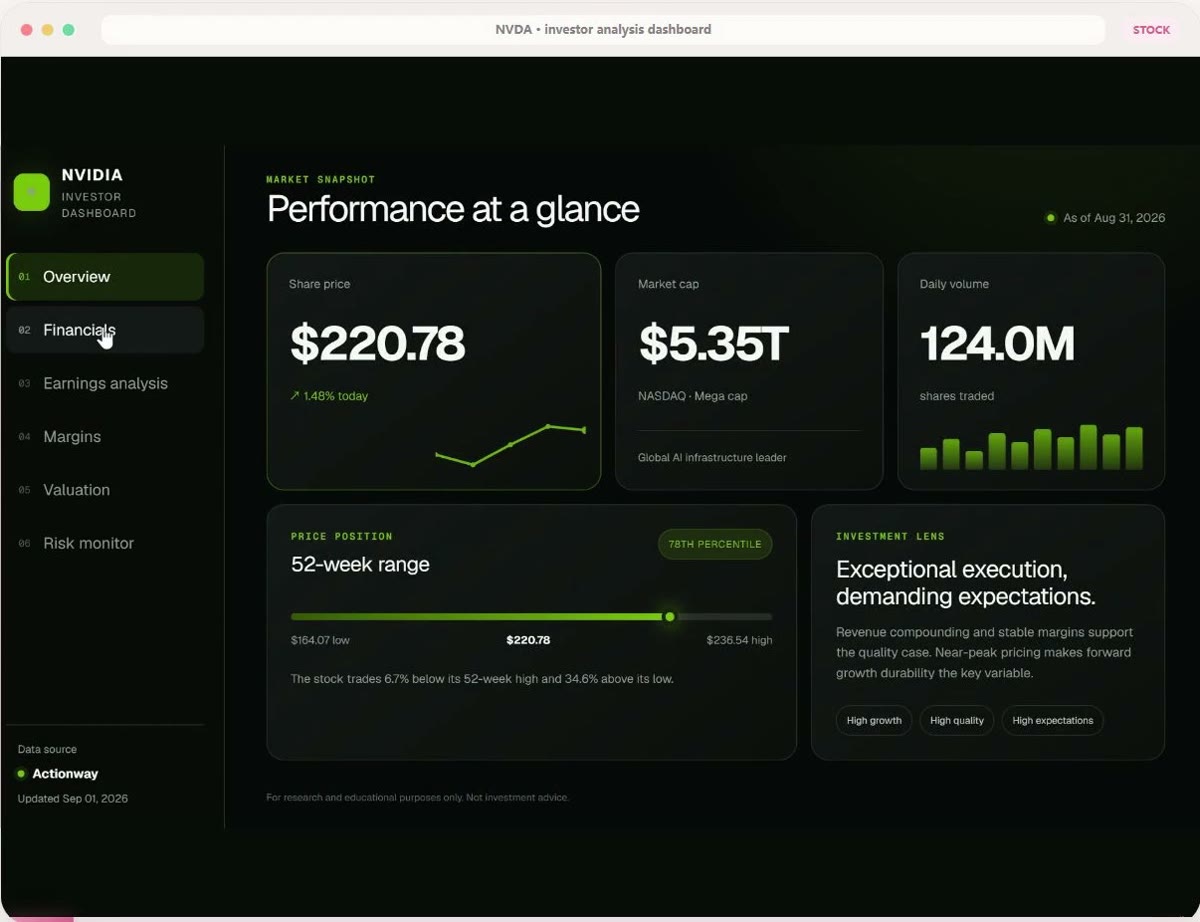
price $228.45  (+1.80%)   market cap $5.53T   52-week range $164.07–236.54

fiscal year   revenue      net income   diluted EPS
FY2026        $215.94B     $120.07B     4.90
FY2025        $130.50B     $72.88B      2.94
2 calls · Market Quote $0.01 per run + Income Statement $0.01 per run · charged on completion
That is a real session, unedited: one question in, two priced data calls, a table out. Every model has a training cutoff and your questions do not, so when a task needs today's numbers Claude Code has to fetch them from somewhere. Actionway is that somewhere — the stock and company data and weather alerts capabilities return structured records, not pages to scrape.
What happened in between
Before answering, the agent checked the capability index it keeps locally, so the first reply already carried the plan: which services, and what each costs per call. It lists them neutrally — no default, no recommendation; say "you pick" and it takes the best-fitting tier. Naming the services you want is the approval: the calls run at the shown price and Actionway checks the wallet on its side. Only calls the platform flags for extra confirmation pause for another question first.
Data calls are synchronous, so there is no job to wait on — the JSON is in the agent's hands within the turn, and the summarizing, table-building, and charting are ordinary local work at no extra cost. If the wallet cannot cover a call, the agent stops before anything is charged and gives you a top-up link with the amount prefilled.
Pick a service, pay per call
Three services cover the finance basics, each at a small catalog price: securities search ($0.01 per run) resolves a company name to its symbol, market quote ($0.01 per run) returns the latest available quote for one or more symbols, and income statement ($0.01 per run) returns standardized annual or quarterly statements. The prices are rendered from the same registry the API catalog shows, so they match what your agent quotes.
The U.S. weather alert services are free: list the active alerts for a state, territory, or marine area, fetch one alert's full detail by its identifier, or list the alert event types before filtering. That makes them a good first live-data call — a morning check wired into a routine never touches your wallet. Behind the basics sits a long tail of live endpoints — social statistics, market data families, public datasets — that the agent discovers with the free actionway tools search. Every call returns JSON the agent can save beside the deliverable, so a brief can cite its own inputs.
Keep the numbers next to the brief
Every call returns JSON, and the agent can save it beside whatever it writes. Ask for that explicitly — "save the raw responses next to the brief" — and the folder ends up with the quote, the statements, and the summary side by side. A month later the same request produces a second set, and a diff between the two is a real change log rather than a memory of what the number used to be. Because each call has a receipt, the wallet statement doubles as a record of when each figure was fetched.
The brief itself is the agent's work and costs nothing: it reads the two responses, computes year-over-year growth, margin, and EPS change, and writes the paragraph. Ask for a chart and it draws one locally from the same JSON. What it should not do is fill gaps from memory — if a quarter is missing from the statement response, the honest brief says so, and a second income statement call for that period is one more $0.01 per run rather than a guess.
こう頼む
Do the same for AMD and MSFT, then put all three revenue tables in one file and flag any company whose latest fiscal-year revenue grew less than 20%.
Three symbols means three quote calls and three statement calls, each listed with its price before they run; the comparison and the flagging are local.
Set it up once
npm install --global @actionway/cli@latest
actionway init
mkdir -p "$HOME/.claude/skills"
cp -R "$HOME/.actionway/skill/actionway" "$HOME/.claude/skills/actionway"You need Node.js 20 or newer and an Actionway account; after sign-in the agent reports your wallet balance and, if it is empty, links you straight to top-up. Prefer a plugin or a Remote MCP server instead of a CLI? Both routes end at the same catalog and the same wallet — the get started page lists the steps per client side by side, and the image generation guide shows the same install with a media run.
よくある質問
Can Claude Code pull live stock prices?Yes, through Actionway: the market quote service returns price, change, market cap, volume, and the 52-week range as JSON for $0.01 per run, and the agent can chart or tabulate it in the same session.
How do I get financial statements into Claude Code?Ask for them. The income statement service returns fiscal-year or quarterly revenue, income, and EPS as structured records for $0.01 per run; the agent builds the table and the trend summary itself.
Does Claude Code ask before each data call?No. The agent lists the services with their prices and picking one runs it; free services run immediately. Only runs the platform flags for extra confirmation pause first.